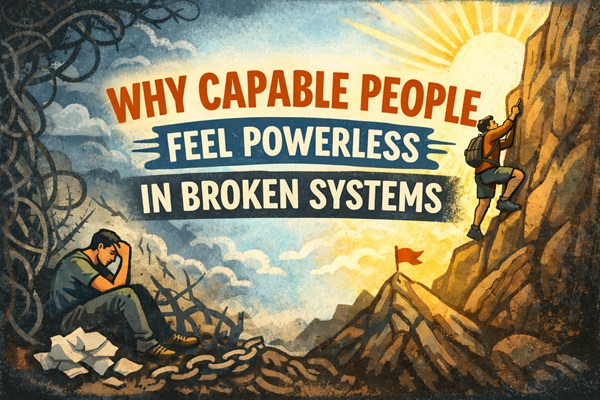
Why Capable People Feel Powerless in Broken Systems
“A system is perfectly designed to get the results it gets.”
~ W. Edwards Deming.
If you are capable but feel powerless,
the problem may not be you.
Many people who think deeply, work hard, and care about doing things well carry a quiet confusion. They know they are capable. Others often rely on them. Yet inside certain environments, they feel small, constrained, and ineffective.
This contradiction is not accidental.
It is structural.

This free Life Reset Blueprint course exists to
help you reset your life calmly and with purpose.
Capability does not guarantee power
We are taught a simple equation.
Be competent.
Work hard.
Follow the rules.
You will have influence.
But many capable people discover the opposite.
They take responsibility, yet have little say.
They deliver results, yet decisions happen elsewhere.
They speak up, yet nothing changes.
Over time, effort without impact creates doubt.
Not because people are weak,
but because the system does not respond.
What broken systems actually look like
Broken systems are not always chaotic.
Many look organised and respectable.
There are meetings.
There are policies.
There are performance reviews.
But beneath the surface, something is off.
Common signs of a broken system:
Decisions are made far from real work
Effort is rewarded with more work, not more voice
Honesty carries risk
Values are discussed, not lived
Control matters more than learning
In these systems, capable people slowly lose power.
Not all at once.
Gradually.
Powerlessness is often learned
Most capable people try at first.
They offer ideas.
They raise concerns.
They suggest improvements.
Then they are ignored.
Or corrected.
Or told to “be realistic.”
Eventually, they stop.
This is not giving up.
It is adaptation.
The nervous system learns that initiative leads to friction, not change.
So it chooses safety over contribution.
Powerlessness becomes a learned response.
Why capable people suffer the most
Capable people are often the first to feel the damage of broken systems.
They notice inefficiency.
They see missed opportunities.
They feel the gap between stated values and lived reality.
This makes them uncomfortable to rigid systems.
Broken systems do not reward insight.
They reward compliance.
So capable people face a quiet choice:
Blend in and shrink.
Or stand out and pay the price.
Many choose to shrink, slowly and silently.
The hidden cost of shrinking
When capable people stay in broken systems too long, the cost shows up in subtle ways.
Loss of confidence
Chronic tiredness
Emotional numbness
Overthinking simple tasks
Feeling invisible despite effort
They still function.
They still perform.
But without energy or belief.
This is not burnout from doing too much.
It is burnout from doing the wrong things in the wrong place.
Systems shape behaviour more than motivation
We often misdiagnose what we see.
We say:
“They lack initiative.”
“They resist change.”
“They are not motivated.”
But behaviour follows environment.
Healthy systems invite thinking.
Broken systems punish it.
In broken systems:
Silence feels safer than honesty
Obedience feels safer than leadership
Blending in feels safer than contribution
Feeling powerless is not a personal flaw.
It is a rational response.
This is not a failure of character
If you feel powerless, pause before blaming yourself.
Ask instead:
“What am I responding to?”
Your frustration may be information.
Your exhaustion may be wisdom.
Your desire to withdraw may be self-protection.
Capable people do not lose power because they lack strength.
They lose power when systems are designed to ignore it.
What restores power
Power does not always come from position.
Often, it begins with clarity.
Consider these questions:
Where am I giving energy without impact?
What truths do I keep quiet to stay safe?
Which values am I constantly compromising?
What does this system reward that I do not respect?
These questions are not about blame.
They are about alignment.
Sometimes power returns by changing how you engage.
Sometimes by changing where you engage.
Sometimes by leaving.
Not all systems can be healed from the inside.
A quiet truth to end with
If you feel smaller inside a system than you do outside it, pay attention.
That feeling is not weakness.
It is perception.
Many systems are outdated, misaligned, or built to preserve control rather than contribution.
You are not imagining this.
And if this names something you could not explain before,
it may help someone else too 🌿
